
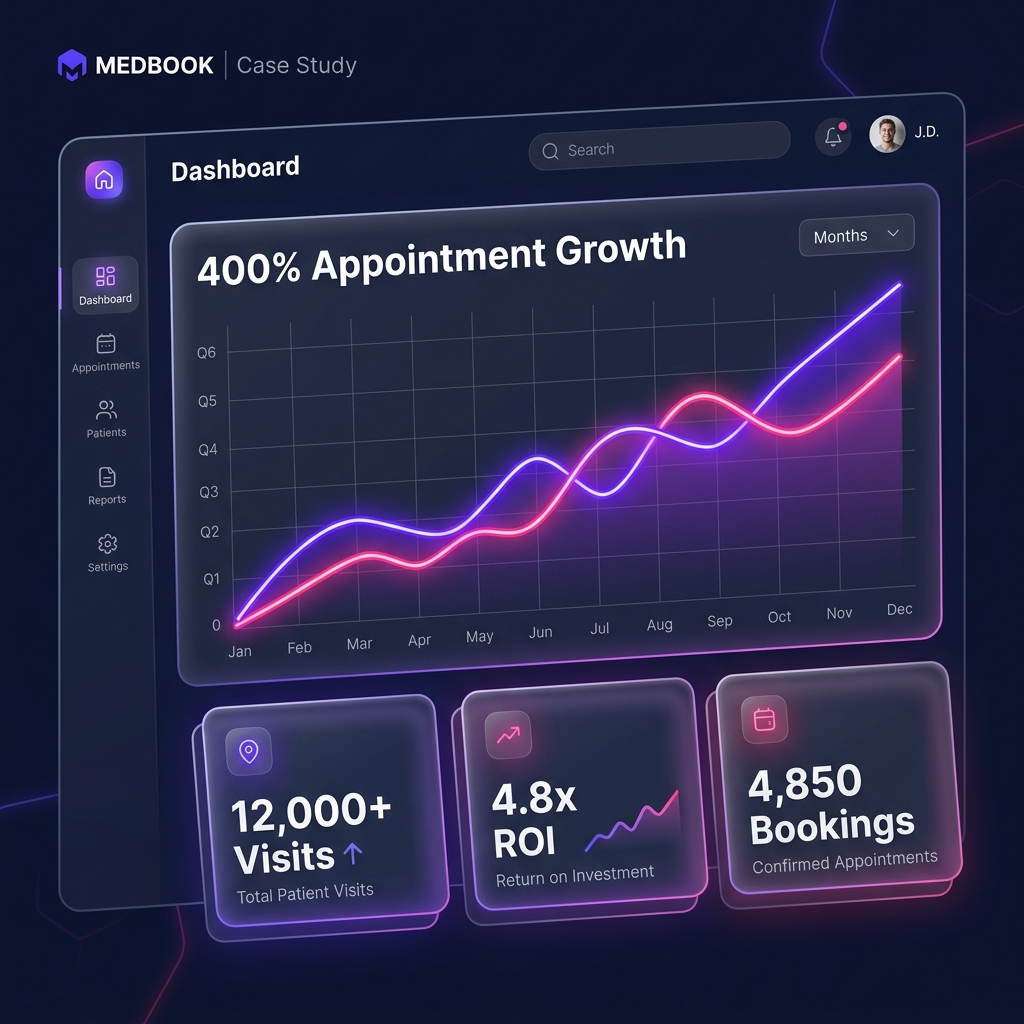
Why Most Clinics Struggle to Fill Appointment Slots
Every clinic — dental, GP, physiotherapy, dermatology — faces the same core problem: patients search on Google, see 3-4 options in the Map Pack, and pick the one with the best reviews, clearest information, and easiest booking process. If your clinic isn't one of those 3-4 options, you're invisible to 80% of potential patients.
The mistake most healthcare practices make is treating marketing like a one-off project. They build a website, maybe run some Facebook ads, and then wonder why the phone isn't ringing. Healthcare marketing is a compounding system: Google reviews build trust, which improves click-through rates, which improves rankings, which generates more reviews. Every piece feeds the next.
This playbook walks through the exact 4-step system we use to fill appointment calendars for clinics — whether you're a single-location dental practice or a multi-site physiotherapy group.
The 4-Step Clinic Growth Engine
Step 1: Google Business Profile Optimisation
Your GBP listing is the most important asset in clinic marketing — more important than your website. 46% of all Google searches have local intent, and for healthcare queries ("dentist near me", "physio [suburb]"), the Map Pack appears above all organic results. If your GBP isn't optimised, nothing else matters.
- Complete every field: services with descriptions, accepted insurance/payment types, hours (including holiday hours), Q&A section
- Add 20+ high-quality photos (exterior, interior, treatment rooms, staff — NOT stock photos)
- Post weekly updates (Google Posts): new services, health tips, seasonal offers
- Primary category must be exact (e.g. "Dentist", not "Medical Centre" for a dental clinic)
- Add secondary categories for each specialty you offer
Step 2: Local SEO & Service Page Strategy
Your website needs a dedicated page for every service you offer, optimised for "[service] + [location]" keywords. A dentist in Auckland shouldn't have one generic "Services" page — they need separate pages for teeth whitening, dental implants, root canal, emergency dentist, each targeting suburb-level keywords.
- Title: "[Service] in [Suburb/City] | [Clinic Name]"
- H1 matches the specific service + location
- 500-800 words covering: what the procedure involves, who needs it, what to expect, pricing transparency (or "from $X" ranges)
- Schema markup: MedicalBusiness, MedicalProcedure (structured data helps Google understand your services)
- Embedded Google Map and clear CTA to book online
Step 3: Google Ads for Immediate Appointments
While SEO builds over months, Google Ads fills your calendar this week. Healthcare Google Ads work differently from other industries — patients are in urgent need and convert fast, but CPCs are higher ($5-25 for dental, $3-15 for physio). The key is tight keyword targeting and call-optimised campaigns.
- Campaign 1 — Emergency: "emergency dentist [city]", "urgent dental care" — highest intent, highest CPC, best conversion
- Campaign 2 — Service-specific: "dental implants [suburb]", "invisalign [city]" — targets high-value procedures
- Campaign 3 — New patient: "dentist accepting new patients", "best dentist [suburb]" — general discovery
- Use call extensions and call-only ads. 60%+ of clinic leads come via phone, not forms
- Schedule ads during reception hours only — don't pay for clicks when nobody answers
Step 4: Review Generation & Reputation Compounding
Reviews are the single biggest factor in clinic marketing. A clinic with 150+ reviews and a 4.7+ average will dominate the Map Pack over competitors with 20 reviews at 4.9. Volume and recency matter more than perfect scores. The clinics that win build a systematic review collection process.
- Send automated SMS/email 2 hours after each appointment with a direct Google review link
- Train reception staff to ask satisfied patients: "Would you mind leaving us a Google review? It really helps other patients find us"
- Respond to every review within 24 hours — positive ("Thank you, Sarah! We're glad the treatment went well") and negative (acknowledge, apologise, take offline)
- Target: 10-15 new reviews per month. At this pace, you'll have 100+ reviews within a year
5 Mistakes That Kill Clinic Marketing
Having one "Services" page instead of individual service pages. Google can't rank a single page for "dental implants Auckland" AND "teeth whitening Auckland" AND "emergency dentist Auckland". Each service needs its own URL, its own content, its own schema markup.
Using stock photos on your Google Business Profile. Google's algorithm can detect stock images. Real photos of your clinic, staff, and equipment build trust with both Google and patients. Clinics with 20+ real photos get 35% more direction requests.
Running Google Ads outside reception hours. If a patient clicks your ad at 9pm and gets voicemail, you've wasted $10-25. Schedule ads to run only when staff can answer the phone. Use call tracking to verify.
Not tracking which marketing channel books appointments. Most clinics know they're "getting calls" but can't tell which calls came from Google Ads vs organic search vs Google Maps. Without call tracking, you can't allocate budget to what works.
Ignoring negative reviews. One unanswered negative review does more damage than ten positive ones. Responding professionally shows prospective patients you care. It also signals to Google that you're an active, engaged business.
Playbook Overview
- Industry: Healthcare Clinics
- Primary Channels: GBP, Local SEO, Google Ads
- Typical Timeline: 2-4 Months
- Best For: Dental, GP, Physio, Specialist
Industry Benchmarks
| Metric | Typical Range |
|---|---|
| Google Ads CPC (Dental) | $5-25 |
| Google Ads CPC (Physio/GP) | $3-15 |
| Cost Per Appointment | $15-60 |
| Click-to-Call Rate | 5-12% |
| GBP Views to Action | 3-8% |
Related Services
Need Help Filling Your Clinic's Calendar?
We help dental, medical, and specialist clinics build patient acquisition systems that compound over time. Get a free audit of your clinic's online presence.