
Direct Answer & Key Takeaways
Learn how to write website copy that turns NZ visitors into leads and customers, with proven frameworks, examples, and common mistakes to avoid.
Your Website Copy Is Probably Losing You Customers Right Now
Most NZ business websites have a copywriting problem they do not know about. The design looks professional. The page speed is decent. But the words on the page — the copy — are silently killing conversions. Visitors land, scan for 3-5 seconds, do not find a compelling reason to stay, and leave.
The difference between a website that converts at 1% and one that converts at 5% is rarely design. It is almost always the copy. The words on your homepage, service pages, and landing pages determine whether a visitor becomes a lead or a bounce statistic.
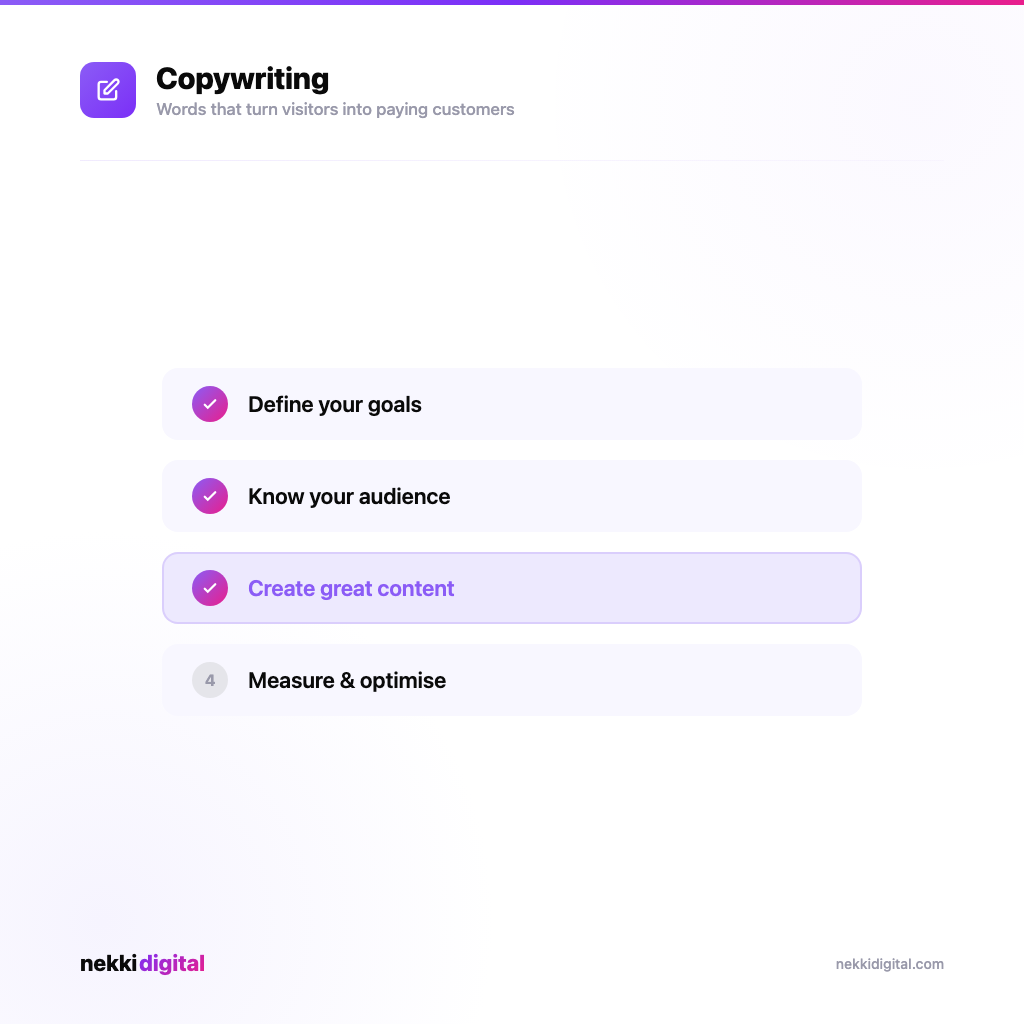
This guide covers the copywriting frameworks, techniques, and NZ-specific approaches that turn website visitors into customers.
The Biggest Copywriting Mistakes NZ Businesses Make
1. Talking About Yourself Instead of Your Customer
The most common mistake. Compare these two homepage headlines:
- Bad: “We are Auckland’s leading provider of comprehensive accounting solutions with 15 years of experience.”
- Good: “Stop stressing about your tax return. We handle it so you can focus on running your business.”
The first talks about the business. The second talks about the customer’s problem and the transformation. Customers do not care about your credentials until they believe you understand their problem.
2. Using Jargon and Corporate Speak
“We leverage synergistic methodologies to optimise your digital ecosystem.” Nobody knows what this means. Nobody cares. Write like you speak. NZ audiences particularly value plain, honest communication — tall poppy syndrome applies to pretentious copy too.
3. Weak or Missing Calls to Action
If every page does not have a clear, specific call to action, you are leaving conversions on the table. “Contact us” is weak. “Get your free quote in 24 hours” is specific and compelling.
4. Feature Dumping Instead of Benefit Selling
Features describe what you do. Benefits describe what the customer gets. Always lead with benefits:
| Feature (Boring) | Benefit (Compelling) |
|---|---|
| 24/7 monitoring | Sleep easy knowing your systems are watched around the clock |
| ISO certified | Your data is protected to the highest international standard |
| Free delivery NZ-wide | Get it delivered to your door, anywhere in NZ, at no extra cost |
| 10 years experience | Avoid expensive mistakes — we have seen (and solved) every scenario |
| Custom reporting | Know exactly where your money is going and what it is returning |
The Conversion Copywriting Framework
Use this structure for every key page on your website:
1. Headline: Problem or Desired Outcome
Your headline has 3-5 seconds to convince a visitor to keep reading. It must do one of two things: articulate the problem they have, or describe the outcome they want.
- Problem: “Tired of Marketing That Costs a Fortune and Delivers Nothing?”
- Outcome: “Get a Steady Stream of Qualified Leads Without the Guesswork”
2. Subheadline: How You Solve It
Immediately below the headline, explain how you make the desired outcome happen: “We build data-driven Google Ads campaigns that bring you customers who are ready to buy — and we prove every dollar spent.”
3. Social Proof: Why They Should Trust You
Testimonials, client logos, review scores, case study results, media mentions. Place these high on the page — before visitors need to scroll far.
4. The Offer: What They Get
Clearly describe what happens when they take action. Not just “our services” but the specific outcome and process: “In your free 30-minute strategy call, we will analyse your current marketing, identify your 3 biggest opportunities, and give you an actionable plan — whether you work with us or not.”
5. Call to Action: Make It Specific and Low-Risk
Strong CTAs reduce perceived risk and create urgency:
- “Get Your Free Audit” (specific, free, no commitment)
- “Book a 15-Minute Call” (time-bounded, low investment)
- “See Pricing” (direct, no games)
- “Start Your Free Trial” (risk-free action)
Page-by-Page Copywriting Guide
Homepage
Your homepage is not a brochure. It is a sorting mechanism. Visitors need to immediately understand: what you do, who you do it for, and why they should choose you. Structure:
- Hero: Problem-focused headline + subheadline + primary CTA
- Trust bar: Client logos or “As seen in” logos
- 3-4 core services with benefit-focused descriptions (not feature lists)
- Social proof section: Testimonials with specific results
- Brief “Why us” section (3 differentiators, not 10)
- Secondary CTA
Service Pages
Each service page should read like a mini sales page. Structure:
- Headline addressing the problem this service solves
- 2-3 paragraphs explaining the approach (customer-focused)
- Benefits list (what the customer gets, not what you do)
- Process steps (how it works — reduces uncertainty)
- Case study or testimonial specific to this service
- Pricing indication (at minimum, a range or “starting from”)
- FAQ section addressing common objections
- Clear CTA
About Page
Surprisingly, the About page is often the second or third most visited page. NZ visitors use it to decide if they trust you. Do not write a corporate biography. Tell a story:
- Why you started the business (the problem you saw)
- Who you help and what you believe in
- Your team (photos and brief bios — NZ audiences value personal connection)
- Results you have delivered (specific numbers)
- CTA: “Ready to work with us?”
Writing for NZ Audiences Specifically
NZ consumers have distinct communication preferences that should shape your copy:
- Be direct but not aggressive: Kiwis appreciate straightforwardness but dislike hard-sell tactics. “Here is what we do and what it costs” works better than “LIMITED TIME — ACT NOW!!!”
- Show, do not boast: Tall poppy syndrome means overt bragging backfires. Let results and testimonials do the talking instead of superlatives.
- Use NZ English: “Optimise” not “optimize.” “Colour” not “color.” Using American English on a NZ business website feels off and signals you may not be local.
- Reference NZ context: NZD pricing, NZ case studies, NZ market data, NZ city names. The more locally relevant your copy, the more it resonates and the better it ranks for NZ searches.
- Authenticity over polish: NZ audiences often respond better to genuine, slightly informal copy than to slick corporate messaging. Write like a knowledgeable friend, not a billboard.
SEO Copywriting: Ranking and Converting
Good copy does not just convert visitors — it attracts them. SEO copywriting means writing content that ranks in Google AND persuades humans to take action:
- Target keywords naturally: Include your primary keyword in the H1, first paragraph, one H2, and meta title. Do not force it — if it reads awkwardly, rewrite.
- Answer search intent: If someone searches “best plumber Auckland,” they want to find and compare plumbers. Your page should make comparison easy (pricing, reviews, service areas).
- Use heading hierarchy: H1 for the page title, H2 for major sections, H3 for subsections. This helps Google understand your content structure.
- Write comprehensive content: Thin pages (under 300 words) rarely rank. Service pages should be 800-1,500 words. Blog posts should be 1,500-2,500 words.
- Internal linking: Link between related pages and blog posts to build topical authority and keep visitors on your site.
Case Study: NZ Service Business — 3.2x More Leads from Copy Rewrite Only
A Wellington-based IT services company had a professional-looking custom website with decent traffic (1,800 monthly visitors) but a poor conversion rate (0.9%). The design was fine. The copy was the problem: feature-heavy, jargon-filled, and focused entirely on the company rather than the customer.
We rewrote the copy on 5 key pages (homepage, 3 service pages, about page) without changing the design:
- Homepage: Changed headline from “Managed IT Services Provider” to “IT Problems Slowing Your Business Down? We Fix Them Fast.” Added client testimonials with specific metrics. Rewrote service descriptions as benefit statements.
- Service pages: Led with the problem each service solves. Added “How it works” process steps. Included pricing ranges and FAQ sections addressing common objections.
- CTAs: Changed every “Contact Us” to specific offers: “Get a Free IT Health Check,” “Book a 15-Minute Call,” “See Our Pricing.”
Results after 8 weeks (same traffic, same design): Conversion rate increased from 0.9% to 2.9% (3.2x improvement). Monthly leads increased from 16 to 52. Bounce rate dropped from 62% to 44%. Average session duration increased from 1:40 to 3:10. The company estimated an additional $180,000 in annual revenue from the copy changes alone.
Frequently Asked Questions
How long should website copy be?
Homepage: 600-1,200 words. Service pages: 800-1,500 words. Landing pages: 500-2,000 words (depending on offer complexity). About page: 400-800 words. Blog posts: 1,500-2,500 words for SEO purposes. Longer is not always better — the right length is however many words it takes to address all customer questions and objections for that page. Do not pad with filler.
Should I hire a professional copywriter?
For your highest-value pages (homepage, main service pages), professional copywriting typically delivers 2-5x ROI through improved conversion rates. NZ copywriters charge $500-$2,000 per page depending on research and complexity. For blog content, you can write it yourself if you have industry expertise, but get someone else to edit for clarity and flow.
How do I know if my copy is working?
Track conversion rate by page in Google Analytics. If a page gets traffic but no conversions, the copy (or CTA) is likely the problem. Also monitor bounce rate, time on page, and scroll depth. Low time on page (under 30 seconds) with high bounce rate means visitors are not finding what they expected.
Should I use AI to write my website copy?
AI tools can help draft initial copy, generate ideas, and overcome writer’s block. But AI-generated copy typically lacks the specificity, personality, and NZ context that makes copy truly effective. Use AI as a starting point, then heavily edit with your own expertise, real client stories, and specific data. Never publish unedited AI copy — it is generic by nature and Google increasingly identifies and devalues it.
Free Resources to Go Deeper
- 2026 Digital Marketing Playbook — The complete strategy guide for NZ businesses, with frameworks, benchmarks, and action plans.
- 40-Point NZ Marketing Checklist — Score your current marketing and find exactly where the gaps are.
- Industry Playbooks — See how we approach marketing for different industries across New Zealand.
Words Are Your Highest-Leverage Conversion Tool
You can have the best design, the fastest website, and the most traffic. But if your copy does not speak directly to your customer’s problem and clearly articulate why you are the solution, none of it converts. Fix your copy and your existing traffic becomes dramatically more valuable.
Want a professional review of your website copy? Request a free marketing audit from Nekki Digital. We will analyse your key pages, identify conversion barriers, and recommend specific copy improvements tailored to your NZ audience.
Get in touch to start converting more visitors into customers.
Get a Free Digital Marketing & SEO Audit
Stop guessing why your competitors are outranking you. Get a bespoke audit of your site's SEO, speed, conversion rates, and growth opportunities.
Claim Your Free Audit


Leave a Reply