

Direct Answer & Key Takeaways
How NZ businesses can market effectively during economic uncertainty — cut waste, double down on ROI channels, and emerge stronger than competitors.
When the Economy Tightens, Smart Marketing Becomes Your Biggest Competitive Advantage
Economic uncertainty is not new to New Zealand. Rising costs, tighter consumer spending, and cautious business investment create pressure to cut marketing budgets. But the data from every economic downturn in the past 50 years shows the same pattern: businesses that maintain or strategically increase marketing during tough times gain market share that persists for years after recovery.
Harvard Business Review research found that companies investing in marketing during recessions outperform those that cut by an average of 275% in revenue growth over the following 5 years. Why? Because when competitors go quiet, your share of voice increases. When competitors cut ads, your cost per click drops. When competitors stop producing content, your SEO authority grows unopposed.
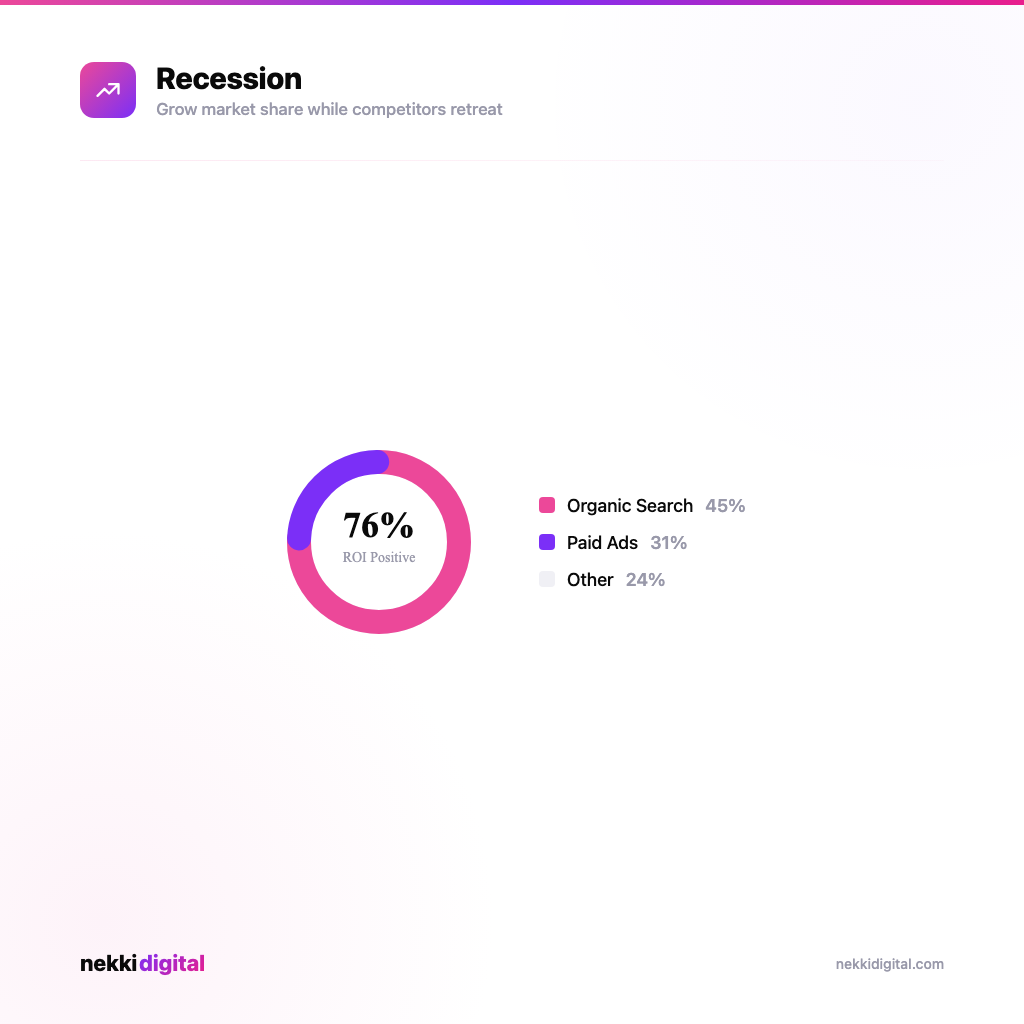
This guide covers how NZ businesses can market smarter (not necessarily bigger) during tough economic periods.
The First Response: Audit Before You Cut
The instinct during tight times is to slash the marketing budget. But cutting blindly is as dangerous as overspending blindly. Before making any changes:
Step 1: Know Your Numbers
| Metric | What It Tells You | Where to Find It |
|---|---|---|
| Cost per lead (CPL) by channel | Which channels deliver cheapest leads | Google Ads, Meta Ads, GA4 |
| Cost per acquisition (CPA) by channel | Which channels deliver cheapest customers | CRM + GA4 attribution |
| Customer lifetime value (CLV) | How much a customer is worth over time | Your accounting/CRM data |
| Marketing ROI by channel | Which channels generate positive return | Revenue attributed to each channel |
| Pipeline value | Future revenue from current leads | CRM pipeline report |
With these numbers, you can make informed decisions about where to cut and where to invest, rather than across-the-board reductions that damage high-performing channels.
Step 2: Cut the Waste, Not the Winners
Common waste in NZ business marketing budgets:
- Underperforming ad keywords: 20-40% of Google Ads spend typically goes to keywords that never convert. Pause them immediately. See our Google Ads troubleshooting guide.
- Vanity social media: Posting 5x/week to platforms that generate zero leads or sales. Reduce to 2-3x and focus on platforms that actually drive business.
- Unused software subscriptions: Audit your marketing tools. Most NZ businesses have 2-3 tools they are paying for but not using effectively.
- Broad awareness campaigns: During tight times, shift budget from brand awareness to direct response (channels with measurable, attributable ROI).
Strategy 1: Double Down on SEO (The Compounding Investment)
SEO is the ideal tough-economy channel because:
- Zero cost per click: Once you rank, traffic is free. Unlike ads where you pay for every visitor.
- Compounds over time: Content published now continues driving traffic for years.
- Competitors cut it first: SEO is usually the first budget cut because it takes time to show results. When competitors stop, you advance faster.
- High-intent traffic: People searching for solutions have active need — they are ready to spend even in tight economies.
Specifically for NZ businesses during uncertain times:
- Create content targeting “cost-effective” and “affordable” keywords (search volume increases during downturns)
- Target local SEO aggressively — local customers are more likely to buy from nearby businesses
- Publish comparison content (“PPC vs SEO“, “in-house vs agency”) as businesses evaluate options more carefully
Strategy 2: Tighten Your Google Ads (Efficiency Over Volume)
Do not turn off Google Ads — make them more efficient:
- Pause broad match keywords: Switch to phrase and exact match to eliminate wasted spend on irrelevant searches
- Aggressive negative keywords: Review search terms weekly and exclude anything that does not match commercial intent
- Focus on BOFU keywords: “Buy,” “hire,” “quote,” “cost” keywords convert at 2-3x the rate of informational keywords
- Geographic tightening: Narrow to regions you can actually serve. “Presence only” targeting prevents wasted clicks from outside your area.
- Improve landing pages: Better landing pages improve conversion rate, effectively reducing CPA without increasing budget
- Add remarketing: Remarketing converts at 2-3x cold traffic at lower CPCs. Allocate 15-20% of ad budget to remarketing.
Strategy 3: Maximise Email (Your Cheapest Channel)
Your email list is free to reach. During tough times, lean heavily into email:
- Increase email frequency: If you send monthly, go fortnightly. If fortnightly, go weekly. More touchpoints = more opportunities to convert.
- Focus on value: Help your audience save money, be more efficient, or solve problems. Value-first content builds loyalty that persists through the downturn.
- Re-engage past customers: It costs 5-7x more to acquire a new customer than to retain an existing one. Email your past customer base with relevant offers, check-ins, and incentives to return.
- Referral campaigns: Ask happy customers for referrals via email. Referral traffic has the highest conversion rate of any source.
Strategy 4: Build Authority While Others Go Quiet
When competitors reduce their marketing, the content landscape becomes less competitive:
- Publish more frequently: While competitors publish less, your content has less competition for attention and rankings.
- Be visible on LinkedIn: For B2B, consistent LinkedIn posting during a downturn positions you as a stable, thriving business. Prospects gravitate toward businesses that look confident.
- Collect testimonials and case studies: Use this period to document client success stories. Social proof becomes even more powerful when buyers are cautious and risk-averse.
- Improve your website: Use lower-pressure periods to fix technical issues, improve website copy, and optimise conversion funnels.
Strategy 5: Focus on Customer Retention
In a tough economy, your existing customers are your most valuable asset:
- Proactive check-ins: Call your top clients. Ask how they are doing. Offer to help. Genuine care builds unbreakable loyalty.
- Flexible pricing/packaging: If clients are struggling, offer adjusted packages rather than losing them entirely. A client paying $2,000/month is better than a client who cancels completely.
- Upsell and cross-sell: It is easier to sell more to existing customers than to find new ones. Identify which of your services would genuinely help current clients.
- Ask for reviews and referrals: Satisfied clients are willing to help — especially during tough times when community support matters more.
What NZ Businesses Got Wrong During Previous Downturns
- Cutting all marketing spend: Businesses that went dark lost brand awareness and market share that took 2-3 years to rebuild after the economy recovered.
- Racing to the bottom on price: Competing purely on price during a downturn erodes margins and trains customers to expect discounts permanently. Compete on value instead.
- Stopping investment in digital: NZ businesses that stopped investing in their websites and digital marketing during 2020 found themselves years behind competitors who continued investing when economic activity resumed.
- Ignoring data: Making emotional budget cuts instead of data-driven decisions. The businesses that audited performance and cut waste (while maintaining winners) came out strongest.
Budget Reallocation Framework for Tight Times
| Channel | Typical Budget % | Recession Budget % | Why |
|---|---|---|---|
| SEO / Content | 25% | 35% | Increase: compounds, free traffic, less competition |
| Google Ads (Search) | 30% | 25% | Tighten: focus only on highest-intent, highest-ROAS keywords |
| Social Media Ads | 15% | 5% | Reduce: shift to organic social and remarketing only |
| Email Marketing | 10% | 15% | Increase: cheapest channel, highest ROI, owned audience |
| Remarketing | 5% | 15% | Increase significantly: highest conversion rate of any ad type |
| Brand/Awareness | 15% | 5% | Reduce: shift budget to direct response channels |
Case Study: NZ Retailer — Grew 23% During Industry Decline
A Christchurch-based specialty retailer saw competitors cutting marketing budgets by 40-60% during an economic slowdown. Industry revenue declined 15% year-over-year. Instead of following suit, they reallocated:
- Cut: Reduced Facebook awareness ads from $2,000 to $400/month. Paused sponsorships and events. Cancelled 3 unused software subscriptions ($380/month saved).
- Maintained: Google Search Ads (tightened keywords, improved Quality Scores). Email marketing (increased frequency from monthly to weekly).
- Increased: SEO content (published 8 new product guides and buying advice articles). Remarketing (increased budget from $200 to $800/month). Customer email campaigns (re-engagement, loyalty offers, referral programme).
Results over 12 months: While the industry declined 15%, this business grew revenue 23%. Google Ads CPC dropped 30% (less competition). Organic traffic grew 85% (competitors stopped publishing). Email revenue grew 140% (more frequent, more relevant sends). Customer retention rate: 78% (industry average: 52%). When the economy improved, they were the #1 ranked website in their NZ niche, a position competitors could not reclaim for 2+ years.
Frequently Asked Questions
Should I cut my marketing budget during a recession?
Reallocate, do not eliminate. Cut waste (underperforming ads, unused tools, vanity metrics) and redirect that budget to high-ROI channels (SEO, email, remarketing, high-intent PPC). The total budget may decrease, but the efficiency should increase significantly. Businesses that completely cut marketing typically lose 2-3 years of growth.
What is the minimum marketing spend for a NZ business during tough times?
As a minimum, maintain your SEO (even basic content publishing), email marketing, and conversion tracking. This can be done for $500-$1,500/month NZD total. If you have any ad budget, allocate it to the highest-ROAS keywords and remarketing only. See our budget allocation guide for detailed calculations.
Is it ethical to market aggressively when others are struggling?
Marketing is not exploitation. Providing valuable services and making them visible to people who need them is a positive contribution to the economy. The key is to lead with value, empathy, and genuine helpfulness — not predatory tactics or fear-based messaging. Help your audience solve their problems, and business growth follows naturally.
How do I convince my boss or board to maintain marketing spend?
Present data: (1) Show the ROI of current marketing channels, (2) Present research on businesses that maintained marketing during past downturns vs those that cut, (3) Show competitive opportunity — which competitors have gone quiet and what market share is available, (4) Propose a focused, efficient plan (not the same plan as before) that maximises return on every dollar.
Free Resources to Go Deeper
- 2026 Digital Marketing Playbook — The complete strategy guide for NZ businesses, with frameworks, benchmarks, and action plans.
- 40-Point NZ Marketing Checklist — Score your current marketing and find exactly where the gaps are.
- Industry Playbooks — See how we approach marketing for different industries across New Zealand.
Economic Uncertainty Is a Strategy Accelerator
The businesses that thrive during tough economies are not the ones that hibernate. They are the ones that get smarter, more efficient, and more visible while competitors retreat. Every NZ recession has produced breakout businesses that used the downturn as a springboard.
Need help making your marketing budget work harder? Request a free marketing audit from Nekki Digital. We will identify waste in your current spend, find high-ROI opportunities, and build a lean strategy that grows your business regardless of economic conditions.
Get in touch to build a recession-proof marketing strategy.
Get a Free Digital Marketing & SEO Audit
Stop guessing why your competitors are outranking you. Get a bespoke audit of your site's SEO, speed, conversion rates, and growth opportunities.
Claim Your Free Audit


Leave a Reply